AI GENERATED - Furniture made by combining materials
Summary
With the continuous upgrade of generative AI tools, designers’ ability to utilize AI is becoming essential.
Based on this background, I thought about various ways to collaborate with AI as a creator, and after thinking about it, I tried a new way of working to derive unstructured furniture design using AI and incorporate human handcraft technology into it to create furniture.
Based on this background, I thought about various ways to collaborate with AI as a creator, and after thinking about it, I tried a new way of working to derive unstructured furniture design using AI and incorporate human handcraft technology into it to create furniture.
Concept
Furniture that serves as a beautiful object and displays with an artistic sensibility are elements that enhance the value of products for customers.
Even in spaces with commercial purposes, there is an increasing trend toward spaces that break away from conventional frameworks and resemble art galleries, where the space itself serves as branding.
In this environmental context, we decided to try collaborating with generative AI instead of artists. The process of creating furniture designs generated by AI based on the materials and functions desired by the designer, and then producing them as physical objects, could itself become a new way of working.
In this environmental context, we decided to try collaborating with generative AI instead of artists. The process of creating furniture designs generated by AI based on the materials and functions desired by the designer, and then producing them as physical objects, could itself become a new way of working.
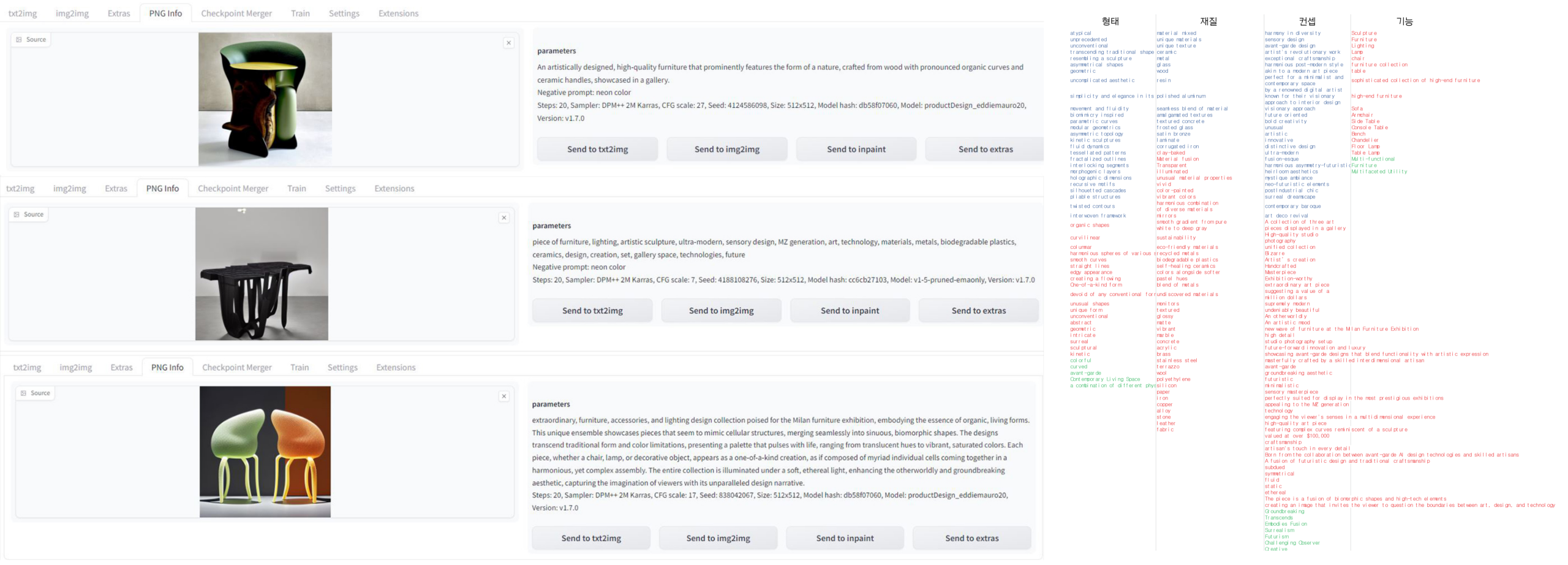

Prompt
To select the desired images, we researched prompts. First, we categorized the prompts into ‘shape,’ ‘material,’ ‘concept,’ and ‘function,’ and listed appropriate prompt words for each category.
Prompts were generated by combining words from each category in various ways or by recommending prompts from ChatGPT.
Additionally, to maintain distance from existing designs, specific artists, brands, or image references were excluded from the commands.
Through multiple iterations of extracting drafts, data was accumulated to refine the commands for generating the desired images.

Images
The AI collaboration tool used was Stable Diffusion, and approximately 3,000 image concepts were extracted.
From the 3,000 images, 108 were initially selected based on criteria such as “artistic,” “realistic,” and “combination of different materials.”


Select
We selected 108 design concepts, grouped similar images together, and conducted a vote for each concept.
Following the final vote, eight designs were selected, and we investigated the production methods, production periods, and costs for each. The eight images posted are the designs selected through the vote.


Making
To bring the design to life, we conducted research on materials and production methods we had not previously explored, and organized production ideas for each design, communicating with companies that specialize in different production techniques.
We selected the final partner based on expertise in form and materials, previous production quality, and proactive participation in the project. We decided to use high-density foam as the main material, as it effectively fulfills the role of a comfortable chair while also being easy to shape into non-traditional forms, and decided to proceed with the following two designs for physical prototyping.
We selected the final partner based on expertise in form and materials, previous production quality, and proactive participation in the project. We decided to use high-density foam as the main material, as it effectively fulfills the role of a comfortable chair while also being easy to shape into non-traditional forms, and decided to proceed with the following two designs for physical prototyping.

Final Prototype Design
01 Shapes
Since AI images exist in 2D, the back view is not available. Therefore, the sculpture was drafted using CAD.
Based on the digitized furniture drawings, we created the central structure and form.
For the green chair with a wooden table, we carved a large block of high-density foam to ensure that the table legs and chair shape interlocked.
The pink chair, characterized by linear volume, was constructed with a wooden structure, and various sizes of circular sponge were attached to find the optimal size.


02 Details
Details were refined by comparing them with AI-generated furniture images.
We prioritized durability and stability to ensure the furniture maintains its form over time, rather than being a one-time exhibition piece, while striving to replicate the image as closely as possible.


03 Coating and Painting
A special coating suitable for high-density foam finishing was applied.
This was a challenging task due to the uneven drying of the coating surface on the curved, irregular shapes caused by the rainy season. The coating process was repeated approximately three times over a three-week period.
The wooden table was made by burning the raw wood to achieve a color similar to the design concept.


Final Result
Furniture was completed through the collaboration of AI, the most advanced technology, and human craftsmanship.
The process of studying and systematizing prompts to derive images of a certain quality using generative AI, and the process of bringing the generated furniture images to life as physical objects, each required specialized expertise.
Creators went beyond simply creating new designs and works of art and also gained experience in approaching problem-solving methods within the creative process in a new way.
This project aimed to explore new forms of collaboration between AI and humans and to gain experience through a series of processes. As AI technology continues to evolve, it is crucial for designers to experiment and reflect on how to integrate it with human-specific domains to produce valuable outcomes.
Creators went beyond simply creating new designs and works of art and also gained experience in approaching problem-solving methods within the creative process in a new way.
This project aimed to explore new forms of collaboration between AI and humans and to gain experience through a series of processes. As AI technology continues to evolve, it is crucial for designers to experiment and reflect on how to integrate it with human-specific domains to produce valuable outcomes.


- Amorepacific Creatives
- Product Design
- Stable Diffusion, Ko Jeongsu,
Hyun Younghun, Kim Seunghyun